Part 1: The Quantum Revolution - How a New Reality Threatens Our Digital World
Part 1: The Quantum Revolution - How a New Reality Threatens Our Digital World
The Quantum Revolution
Welcome to Part 1 of the collision between Cybersecurity and Quantum Computing. Before we go through the future of digital defense, we must first understand the nature of the threat. That threat was born from a realm of physics so bizarre. For decades, our digital lives have been protected by layers of cryptography—the mathematical locks that secure everything from our bank accounts to our private messages. These locks have been more than strong enough to resist the brute force of classical computers. But a new type of machine is coming, one that doesn’t play by the old rules. This is the story of how quantum computing will pick those locks with ease.
The Bizarre World of Quantum Mechanics
Normal computers work in bits, a representation where tiny switches are either OFF (a 0) or ON (a 1). Basically, it’s a world of absolutes.
However, quantum computers operate in a world of possibilities. They use qubits that have other principles, such as:
Superposition: The “Both at Once” Principle
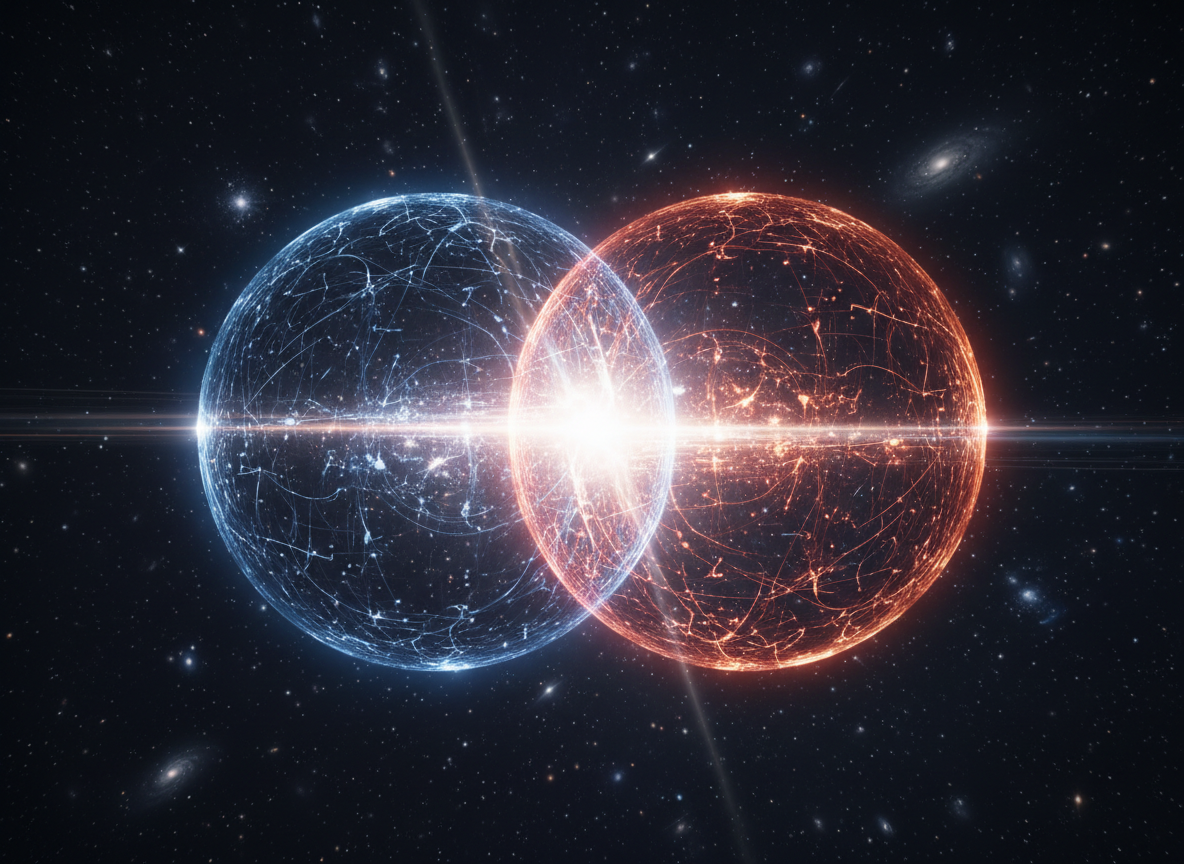
A qubit isn’t just a 0 or a 1; it can be a combination of both states simultaneously. It sounds illogical, right? But this is Superposition. The classic analogy is a spinning coin. While it’s in the air, it’s neither heads nor tails; it’s a superposition of both. Only when it lands—when we measure it—does it get a definitive state.
By placing qubits in a state of superposition, a quantum computer can process a vast number of calculations at the same time. A 2-qubit computer can perform 4 calculations at once, and a 3-qubit computer can perform 8. (This might not sound interesting, but let me tell you something: a 300-qubit computer could explore more states than there are atoms in the known universe.)
Decoherence
To be more clear about superposition, it’s very fragile. The slightest interaction with the outside world—a tiny change in temperature, a small magnetic field, even a small vibration—can cause a qubit’s decoherence, collapsing out of its superposition and randomly choosing to be a 0 or a 1.
When a qubit decoheres, any calculation it was part of is ruined. This loss of “quantumness” is the single biggest engineering challenge in building a large, stable quantum computer. Much of the work in the field is dedicated to creating better error-correction and shielding qubits from the environment.
The Cryptographic Target: RSA Encryption
So how does this new form of computing threaten our security? The primary target is Public-Key Cryptography, with the most famous example being the RSA algorithm.
RSA is the backbone of secure communication on the internet. It works using a pair of keys: a public key, which you can share with anyone, and a private key, which you must keep secret.
Imagine you want someone to send you a secure message. You send them an open padlock (your public key). They place their message in a box, snap your padlock shut, and send it back to you. Once locked, that padlock can only be opened by your unique, secret key (the private key).
The mathematical magic behind this is prime factorization.
To create your keys, you secretly choose two extremely large prime numbers and then multiply them together to get an even more massive number, which becomes part of your public key.
The RSA Algorithm rests on a simple fact:
Multiplying those two primes is easy, but factoring the giant result back into the two original primes is impossibly hard for a classical computer. For a key of standard length (2048 bits), the number of operations required is so vast that it would take the world’s most powerful supercomputer trillions of years to break it.
The New Weapon: Shor’s Algorithm
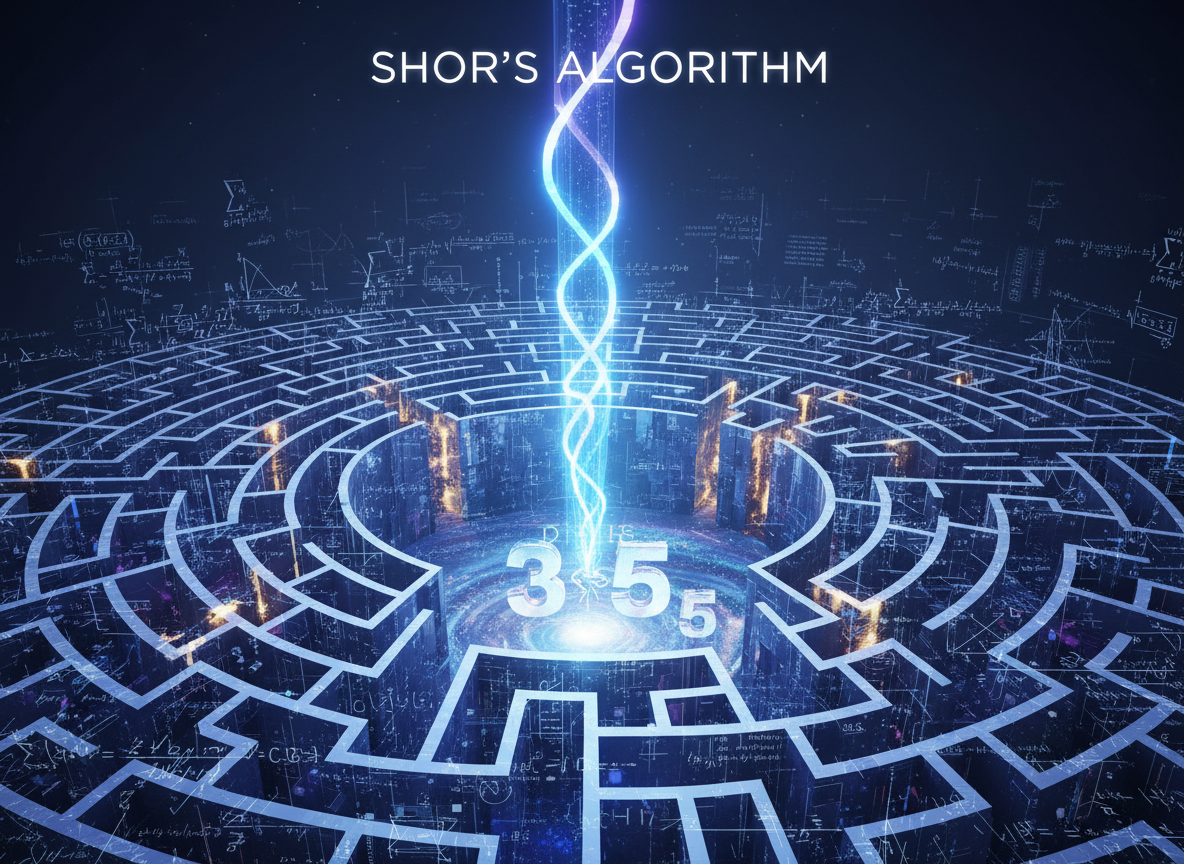
Back in 1994, a mathematician named Peter Shor devised a quantum algorithm that completely demolishes the RSA algorithm.
Shor’s algorithm is not a brute-force attack; it doesn’t guess the two prime numbers. It’s a brilliant method that uses the unique properties of quantum mechanics to find the solution in a new way. Here’s the core idea:
It’s called the period-finding problem. Think of it like finding the repeating pattern in a vast, complex wallpaper design. A classical computer would look at each piece one at a time, but a quantum computer, using superposition, can look at all the pieces at once. It uses a tool called the Quantum Fourier Transform to spot the underlying repeating pattern, which is called the period. Once the quantum computer finds the period, simple math can quickly reveal the original prime factors.
(To get to our point, there is a vast amount of encrypted data today waiting for the day quantum computers will be able to unlock it.)
Proof of Concept in Code
We don’t need to wait for a full-scale quantum computer to prove that Shor’s algorithm works. We can simulate it on a classical computer using quantum development kits like IBM’s Qiskit.
1
2
3
4
5
6
7
8
9
10
11
12
13
14
15
16
17
18
19
20
21
22
23
24
25
26
# A Python example using the Qiskit library to factor 15.
# This demonstrates the fundamental logic of Shor's algorithm.

from qiskit import Aer
from qiskit.algorithms import Shor
from qiskit.utils import QuantumInstance

# The number we want to factor. In a real attack, this would be a massive public key.
N = 15

print(f"Attempting to factor the number: {N}")

# We use a 'qasm_simulator' to mimic a real quantum computer on a classical computer.
backend = Aer.get_backend('qasm_simulator')
quantum_instance = QuantumInstance(backend, shots=1024)

# Create an instance of Shor's algorithm.
shor = Shor(quantum_instance=quantum_instance)

# Execute the quantum algorithm.
result = shor.factor(N)

# Print the results.
factors = result.factors[0]
print(f"The prime factors found by Shor's algorithm are: {factors[0]} and {factors[1]}")
print(f"Verification: {factors[0]} * {factors[1]} = {factors[0] * factors[1]}")
But the story doesn’t end here. For every threat, a defense is born. The same ingenuity that conceived of this quantum weapon is now being channeled into creating a new generation of quantum-resistant armor.
In Part 2 of this series, we will dive into the solutions, exploring the brilliant worlds of Post-Quantum Cryptography and Quantum Key Distribution—our best hopes for a secure digital future.